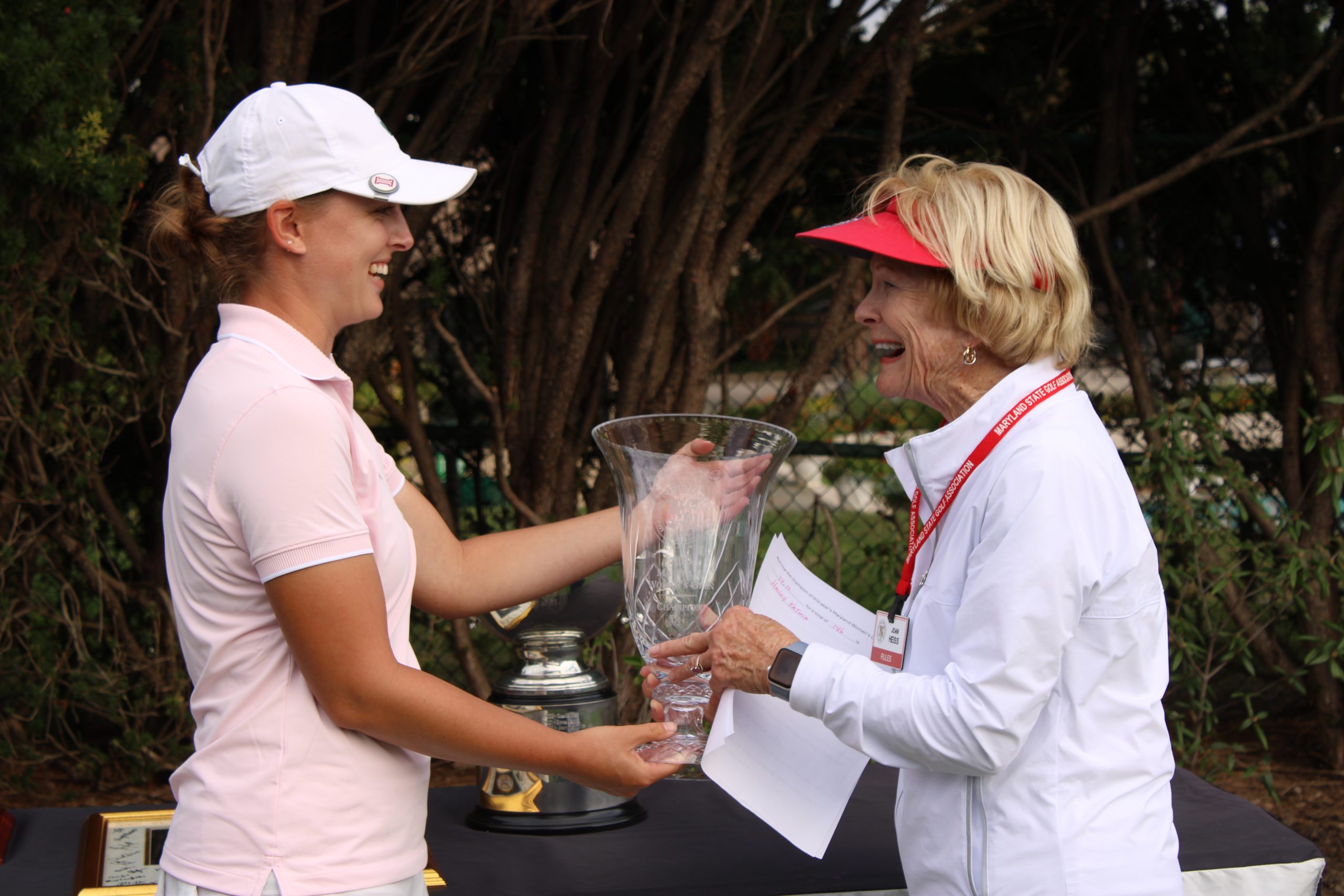
In above picture: Joan Heiss, right, awards Hailey Katona, left, the 2025 Maryland Women’s Open trophy.
Lutherville, Md. – For more than 17 years, the Maryland State Golf Association (MSGA) has been fortunate to have Joan Heiss among its most dedicated volunteers. She has demonstrated a commitment to serving the golf community on the local, statewide, and national levels. Her volunteerism reflects the best of the MSGA’s mission to serve, grow, and advance the game of golf.
Heiss entered the MSGA world first by competing in summer tournaments while on her time off from her teaching job. However, when her role as a teacher expanded to a 12-month position, she was left with less and less time to compete. She eventually stopped playing in the championships. It wasn’t long until she developed a personal earworm in the form of friend and mentor, Diane Herndon, who was persistent in encouraging Heiss to volunteer.
“Diane joined the women’s division several years before I did, and she’s been a good friend of mine forever,” Heiss said. ” She kept trying to talk me into volunteering, and at the time, I was working full-time, and I just wasn’t sure I wanted to do that.” Despite retiring from teaching in 2002, which created an opportunity to get involved at the time, Heiss and her husband moved to the Eastern Shore. Herndon persisted. “She still kept bugging me,” Heiss said with a laugh.
In 2009, Heiss joined the Maryland State Golf Association – Women’s Division (MSGA-WD). Since its founding in 1995, the MSGA-WD has introduced tournaments, scholarships, and programs to advance women’s and junior golf in Maryland and Washington, D.C. In 2022, the Women’s Division formally merged with the MSGA, becoming the MSGA Women’s Committee. Heiss now serves on the MSGA board of directors and chairs the Women’s Committee.
“I really enjoyed it, I did,” Heiss said of those early days with the MSGA-WD. “But what I discovered was, I thought I knew the rules because I’d been playing golf for a long time, and I discovered, having to officiate at these tournaments, that I wasn’t so sure I knew the rules the way I needed to make some decisions.”
Heiss began attending USGA Rules of Golf workshops with Herndon. For Heiss, the classroom setting proved familiar and a perfect fit. “I loved it because, being a teacher, I love learning,” she explained. “It just became a passion for me.”
That passion for education quickly came full circle as Heiss transitioned from a student of the rules to a teacher, now conducting her own rules clinics and seminars across the state. Her dedication quickly expanded beyond state lines as she sought to deepen her roots in the game. Following more encouragement from her mentor, Diane Herndon, who was already serving on national committees, Heiss applied for a committee position with the United States Golf Association (USGA). She began her national service in 2013 on the Senior Women’s Amateur Committee.
Today, she serves as a member of the USGA national committee and a rules official. Her role with the USGA allows her to travel across the country to support various championships. “I love it. We all have that love for knowing the rules and imparting that knowledge to others,” Heiss said of her colleagues. “It’s almost like a fraternity because you are around the same people with the same interests.”
Her national involvement has allowed her to prioritize the tournaments she works each year, ranging from local qualifiers to prestigious national championships. One such national championship is the U.S. Adaptive Open, which was held at Woodmont Country Club in 2025. Heiss was the referee for the final round of Maryland native and U.S. Adaptive Open participant, Ford Martin.
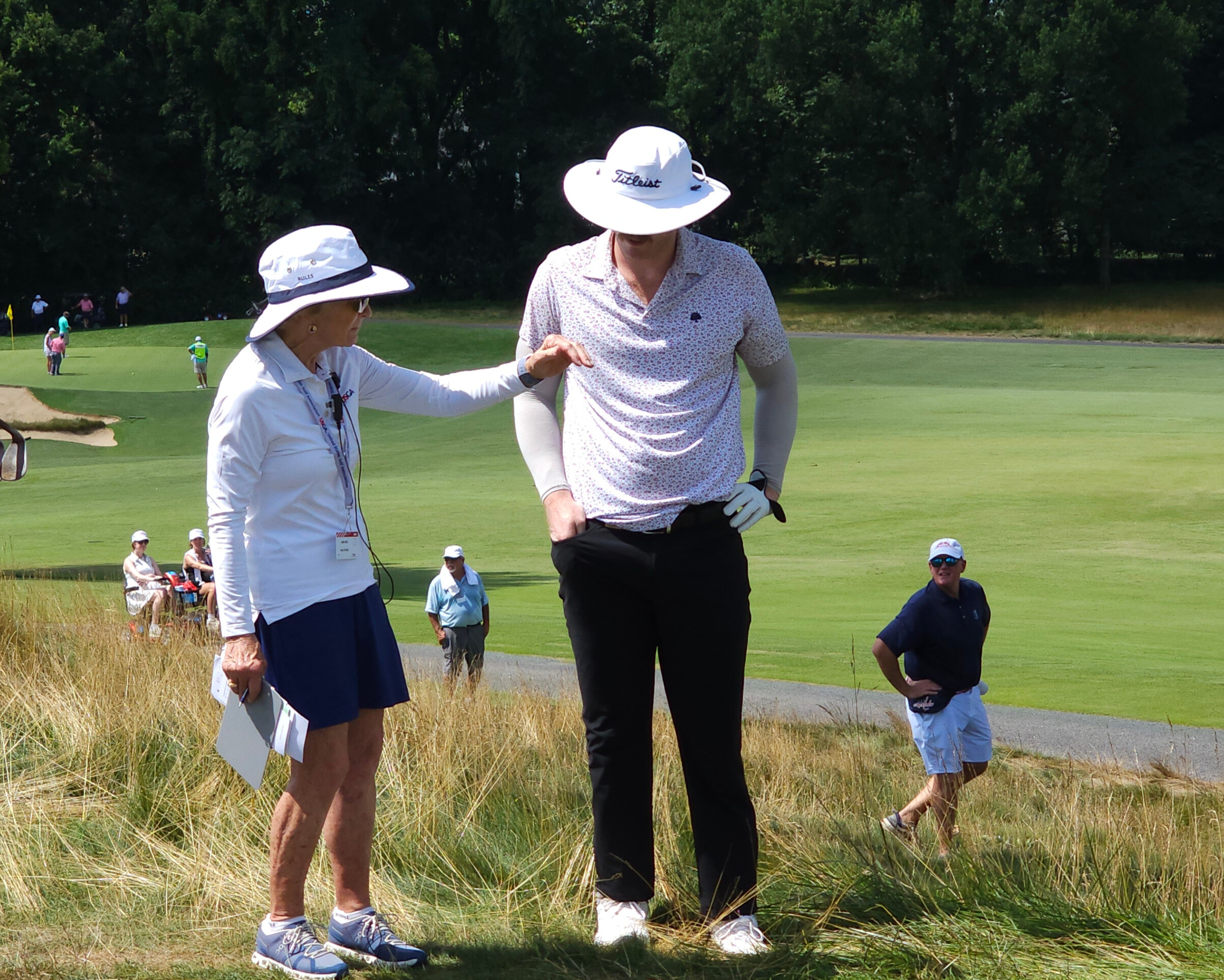
Joan Heiss, left, assists Ford Martin, right, with a ruling during play of the 2025 U.S. Adaptive Open held at Woodmont Country Club. (Cal Lanouette, MSGA)
Despite her expertise, and she is an expert after all, as she has scored a 90 or above on the grueling USGA rules exam, Heiss views her role on the golf course as one of support rather than enforcement. Her goal is to prevent infractions before they happen, often turning on-course situations into teaching moments.
“I’m not there to penalize them, I’m there to help them,” Heiss said. “I enjoy helping players avoid penalty situations so they can maneuver through the game better.” She recalled one such instance in which a player took relief from a cart path, quickly stepped off, and dropped the ball. While their drop was legal, they had shortchanged themselves by not utilizing the full club-length allowance. There was a break in the action, and the group was waiting, so Heiss saw this as a great teaching moment.
“I went over, and I said, ‘Hey, would you be interested in knowing where you would have ended up if you’d followed the whole procedure?'” Heiss said. “They saw it. They would have ended up in the fairway, and they said, ‘Oh my god, I just never thought about that. I will certainly do that from now on.’ That was fun to see an ‘aha’ moment from a player.”
Beyond the rulebook’s technicalities, Heiss says the most fulfilling aspect of volunteering has been watching the next generation of golfers develop. She has watched players grow from young juniors into collegiate athletes and professionals. “I’ve seen these little girls start as an 11-year-old or 10-year-old and watch them go through college and be on college teams, and then have success after that,” Heiss said. “That’s been really rewarding and fun for me to see them grow.”
She points to players such as Aneka Seumanutafa, whom she watched progress from junior golf in Maryland to competing in the prestigious Augusta National Women’s Amateur. She holds a special fondness for Delaney Shah, who is currently pursuing a professional career on the ANNIKA Women’s All Pro Tour. Heiss recalls seeing Shah’s father caddying for her at many tournaments, and she quickly developed a relationship with the father and daughter.
For Heiss, the MSGA and the USGA have become more than just organizations she volunteers for; instead, they feel more like a “fraternity” of like-minded individuals who share a deep love for the game.
Volunteering helps maintain a connection to the world, which has remained very important to Heiss throughout her tenure. “Volunteering keeps me engaged with others,” Heiss shared. “We all have similar goals for the good of the game. There is such camaraderie among the volunteers, and we all do this for the love of the game.”
To those considering joining that camaraderie, Heiss offers a simple endorsement: “You don’t need to be a rules expert to get started, that’s why we have radios.” Heiss added, “The biggest word to me is ‘rewarding.’ You observe such good golf, and the players truly appreciate the help and support we provide.”
2026 will mark the 18th year of volunteering with the MSGA for Heiss. Her path from an occupation as a teacher to an inquisitive student of the rules and, finally, to a rules expert demonstrates the power of lifelong learning and giving back. Her dedication continues to ensure that the game of golf remains fair and educational for all players. Joan Heiss proves that while the rules define the game, it is the spirit of volunteers that defines the golf community.
As a non-profit organization, the MSGA relies heavily on volunteer support and continues to grow through the generosity of these individuals. Volunteers assist the staff in providing the highest level of service to golfers and golf clubs in Maryland. Interested in getting involved with the MSGA? Please visit our Volunteer webpage to learn more.
MSGA Mission
To serve, grow, and advance the game of golf in Maryland and the District of Columbia.